 English
 Chinese
 French
 German
 Russian
 Italy
Italy Spain
Spain Portugal
 Japanese
 Korean
 Arabic
 Traditional
Animal ART Technology
Bovine Bull Breeding Assisted Reproduction Technology

Bovine Bull Breeding Assisted Reproduction Technology
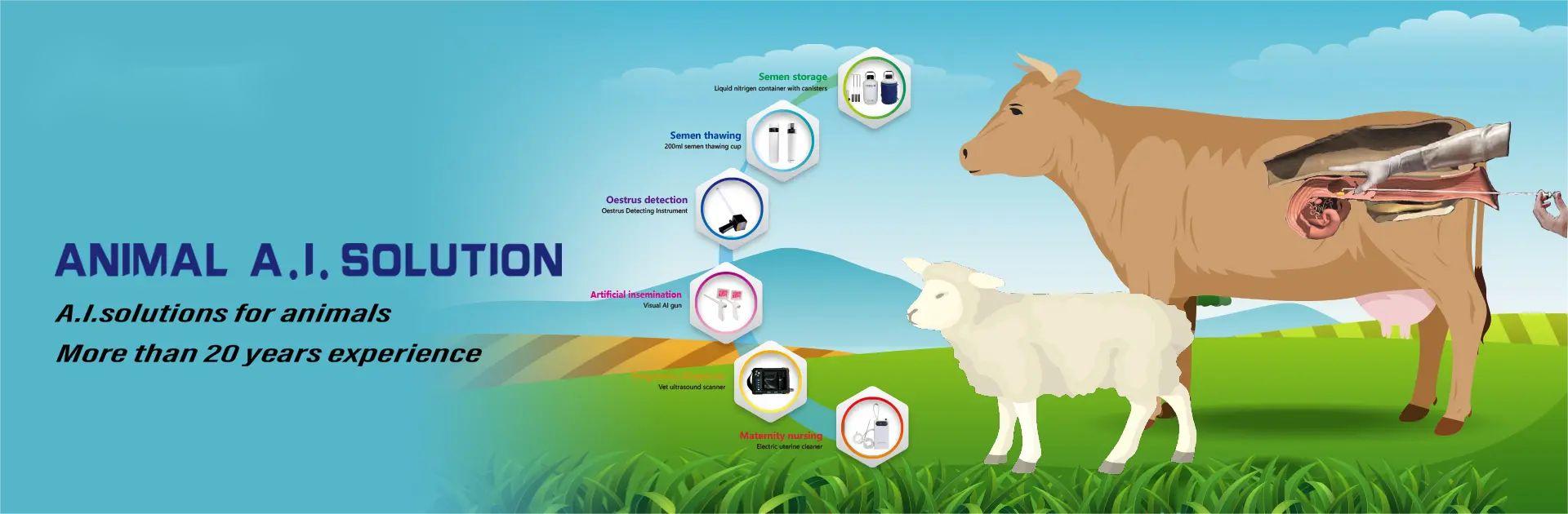
what is Artificial insemination technology for bovine cattle?
Artificial insemination technology for cattle is a highly practical skill. It emphasizes combining technical knowledge with hands-on application. While learning the technique is relatively straightforward, mastering it effectively presents challenges. Below are common non-standard practices observed during AI procedures, analyzed for reference purposes.
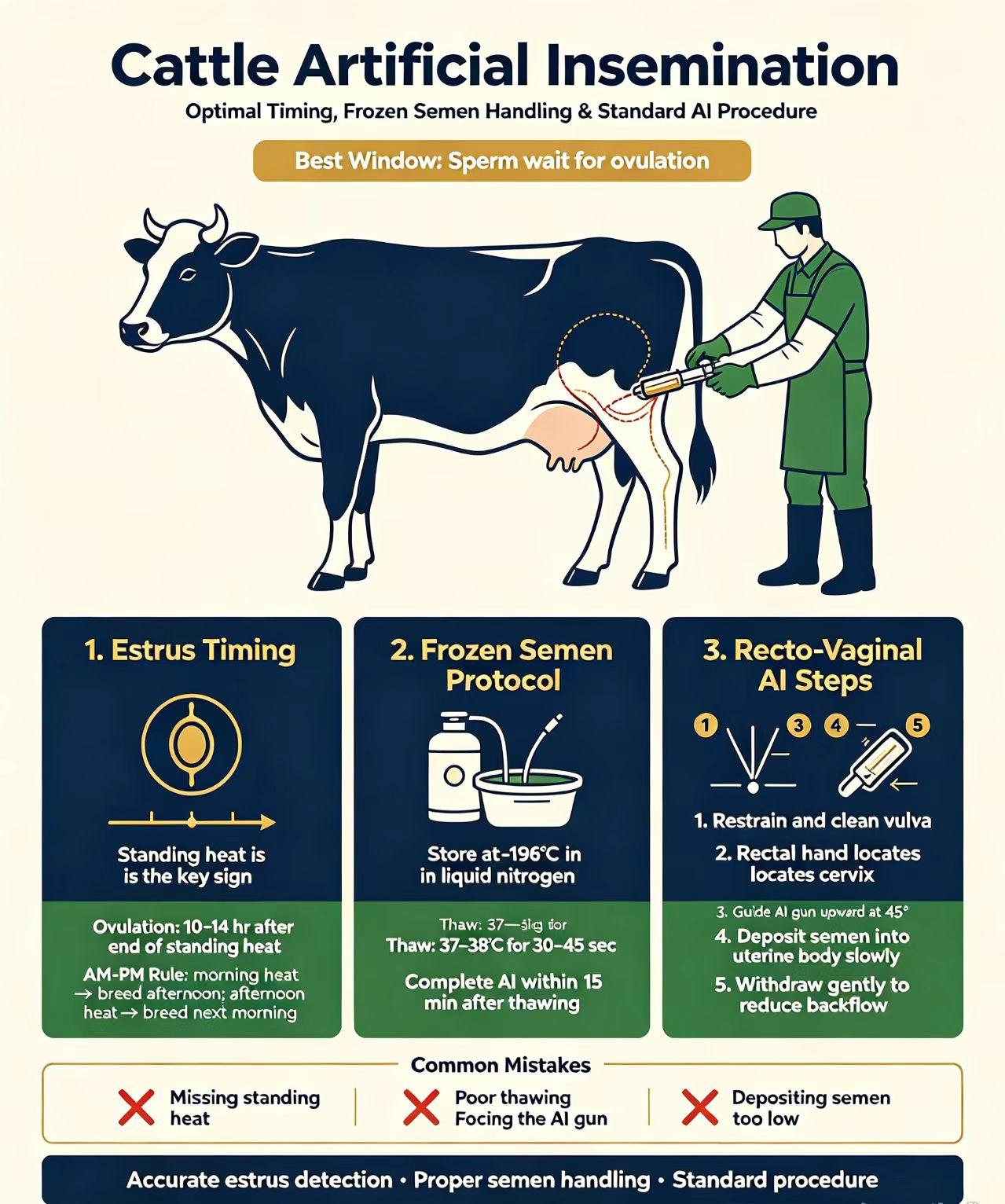
1. Accurately Identifying Estrus Signs and Ovulation Timing Currently, most breeders (inseminators) employ rectal palpation for artificial insemination. Correctly identifying a cow's estrus signs and ovulation timing is fundamental to successful fertilization. However, the vast majority of breeders lack a deep understanding of estrus signs and have inaccurate, or even vague, concepts regarding ovulation timing.
(1) Misconceptions about estrus signs: In practice, most inseminators assume cows that accept mounting are in estrus, i.e., cows that stand in the stall. However, this alone is insufficient. It must be supplemented with “changes in the cow's reproductive tract, normal mucus, and properly developed follicles.” In other words, correct estrus signs should be determined based on three aspects: "external manifestations; mucus color, viscosity, and flow; follicular development."
(2) Misconceptions about ovulation timing: Accurately determining a cow's ovulation time is critical for artificial insemination success—that is, correctly identifying when ovulation occurs. Most breeders believe it happens 6–10 hours after estrus ends. Generally, this is incorrect; the correct window is 4–16 hours. Some inseminators may miss the 4–6 hour and 10–16 hour ovulation windows, thereby reducing conception rates. To ensure higher conception rates, rectal examination should be conducted to assess follicle development on the ovaries. Typically, when follicles reach 1.5–2.0 cm in size, their tips become thin and distended, feeling ready to rupture upon touch. Insemination at this stage generally offers a 100% chance of success.
2. Correct Sequence for Rectal Examination Experienced breeders always perform rectal examinations, but many directly check ovarian follicles, leading to misdiagnosis and failure to exclude cows with uterine inflammation or those pregnant within the past two months. Since cows in these conditions can still exhibit estrus, this results in misbreeding, wasting semen, and causing unnecessary losses of time, effort, and resources. The correct rectal examination sequence is: Insert the gloved hand palm-up into the rectum slowly, then rotate the palm to palpate sequentially from the cervical os through the cervix, uterine body, uterine horns, fallopian tubes, and ovaries. This sequence identifies abnormal reproductive tract conditions, accurately assesses normal physiological states, and enables precise judgments regarding pregnancy, estrus, and inflammation. Of course, textbooks clearly define what constitutes a normal reproductive tract.
3. Mastering the Correct Artificial Insemination Procedure
A proper artificial insemination procedure saves time and effort while minimizing risks of injury to both animal and handler. Here, we focus on analyzing common operational errors. First, when opening the liquid nitrogen tank, invert the lid to prevent contamination. After cutting the tip of the straw, it must not touch any unsterilized objects (before entering the reproductive tract). If the vulva is rinsed with water, it must be followed by cleaning with a 0.1% potassium permanganate solution. The insemination gun tip must not come into contact with the vulva contaminated by water. The insemination gun must not be pointed directly at the operator's body to prevent serious injury if the cow retreats and the gun enters the reproductive tract. Lift the tail root or restrain the cow's hindquarters to prevent accidental injury to the inseminator. After insemination, slowly withdraw the gun while pinching the clitoris or mid-back to lower the cow's hindquarters, preventing semen backflow.
4. Common Misconceptions About Timely Insemination Most breeders determine insemination timing by observing estrus signs: inseminating in the afternoon for cows showing estrus in the morning, or the next morning for those showing estrus in the afternoon. While this method has merit, it lacks precision. Accurate timing requires comprehensive assessment of both internal and external indicators:
(1) External Signs: As the cow enters late estrus, she becomes calm, appetite gradually returns to normal, and when other cows mount, she avoids contact with her hindquarters. Vulval swelling subsides and wrinkles appear.
(2) Mucus: The vaginal mucosa appears dark red, with minimal mucus discharge that is cloudy or grayish-white in color.
(3) Rectal examination: The cervix gradually hardens from the external to internal portion while retaining elasticity; the follicular wall is thin; a distinct pulsation is felt, with a sensation of readiness to rupture upon contact.
Swine Pig Boar Breeding Reproductive Solution
Bovine Bull Assisted Reproduction Breeding
Equine Reproductive Artifcial Insemination
OVINE/CAPRINE Breeding Reproduction Solutions
13509905234
+0755 25114
info@aispermanalysis.com
No.22 Jingxiu East Road,Life Science Park, Pingshan District,Shenzhen City,China
Copyright © 2015 aispermanalysis.com All rights reserved. Zhan Jiang AI SHEN SI Technology Co.,Ltd